Intro to Bioinformatics
This section is here to help you understand how sequencing data are generated, what happens to them next, and how the file formats you will meet along the way fit together. Getting comfortable with these foundations first makes every analysis pipeline in the rest of this resource much easier to follow.
Below we describe how next-generation sequencing works, and then walk through the file formats you will encounter most often: those that come straight off the sequencer, and those produced by the analysis programs downstream.
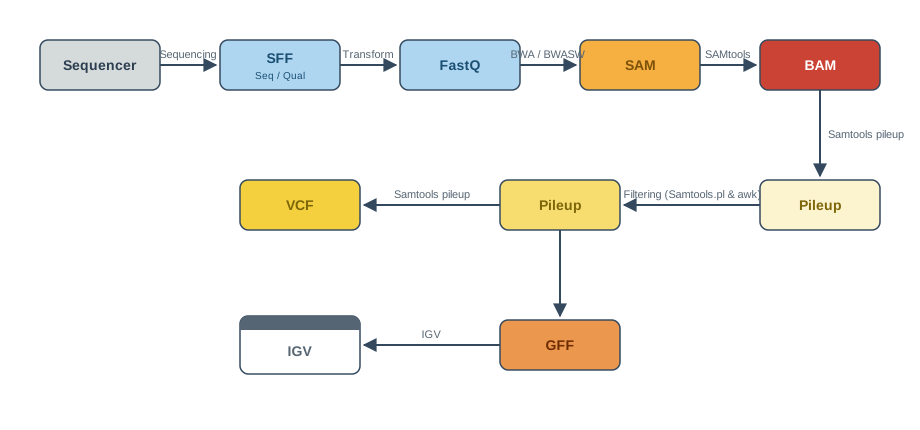
How the file formats in this section relate to one another in a typical analysis. Reads come off the sequencer, are written as FastQ, aligned into SAM/BAM, and then reduced to variants (VCF) and features (GFF) that can be inspected in a genome viewer such as IGV.
Key terms
Before we begin, it is good to be familiar with some terminology that will be used from here on out.
- read
A single sequence produced from a sequencer. Think: a sequencing machine read a molecule and this is what it thinks it is.
- library
A collection of DNA fragments that have been prepared for sequencing. This generally refers to an individual sample.
- flowcell
A chip on which DNA is loaded and provided to the sequencer.
- lane
One portion of a flowcell. Usually used for technical replicates or different samples.
- run
An entire sequencing reaction from start to finish.
The pages below walk through how sequencing works and each of the file formats in turn: